
Introduction
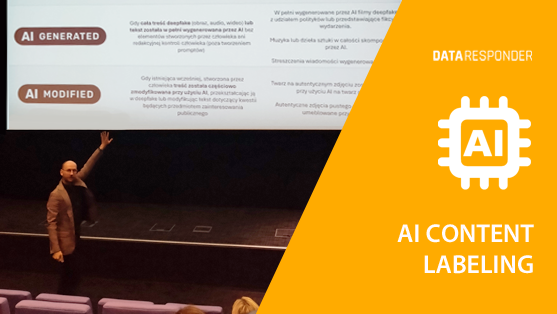
Attending the event “What Does It Mean to Label AI?”, organized by the Pomeranian Science and Technology Park in Gdynia and led by Tomasz Palak – a legal advisor specializing in internet law – was an opportunity to gain a clearer understanding of the obligations associated with using artificial intelligence. As AI becomes increasingly common in marketing, communication, and content creation, an important question arises: when should audiences be informed about the use of artificial intelligence, and when is such disclosure unnecessary?
AI Act – Not Every Use of AI Requires Labeling
One of the key takeaways from the event was the distinction between using AI and being legally required to disclose its use. Article 50 of the EU AI Act defines specific situations where transparency is mandatory, but this does not mean that every AI-generated image or text written with the help of ChatGPT must automatically be labeled.
What matters most is the type of content, publication context, extent of AI involvement, and potential to mislead the audience. Different rules apply to product descriptions, informational content, and realistic visual materials.
When Is AI Content Labeling Required?
During the event, several key situations covered by transparency requirements were discussed:
- Chatbots and voicebots – users should know they are interacting with AI unless this is already obvious from the circumstances.
- Deepfakes – realistic images, recordings, and audio generated or modified by AI that could be mistaken for authentic content.
- Texts concerning matters of public interest – content generated or modified by AI when the verification and editorial control required for an exemption have not been applied.
- Emotion recognition and biometric categorization – individuals subject to such systems should receive appropriate information.
In practice, this means that an AI-generated lipstick description in an online store is generally not subject to the same requirements as an article about health, politics, or significant social issues.
Deepfakes Are More Than Just Face Swaps
One interesting aspect of the presentation was the explanation that the definition of a deepfake under the AI Act is broader than its common understanding. It can include not only a person’s likeness but also realistic representations of existing places, objects, or events that audiences might mistakenly perceive as authentic.
This is particularly relevant to marketing, advertising, and e-commerce, where AI is increasingly used to create visualizations. The key consideration is not only how the material was created, but also what impression it makes on the audience.
Human Verification Still Matters
The AI Act provides an exception for texts intended to inform the public about matters of public interest if they have undergone human review or editorial control and a designated person or organization takes editorial responsibility for their publication.
However, this does not mean that briefly reading AI-generated content is sufficient. Verification should include checking facts, sources, quotations, and the accuracy of the message. AI can speed up the process, but it does not assume responsibility for published information.
Practical Tips for Businesses and Content Creators
Based on the event, several simple principles are worth incorporating into everyday publishing workflows:
- Evaluate the context – consider what the material is about and whether it could be perceived as authentic.
- Verify before publishing – check facts, quotations, and data, even when AI-generated content appears credible.
- Label clearly and precisely – indicate what was generated or modified by AI whenever disclosure is required.
- Document the process – keep records of changes and information about editorial review.
- Check platform policies – social media platforms may have their own requirements for labeling AI-generated content.
Conclusions
The event demonstrated that responsible AI use is not about labeling everything, but about consciously recognizing situations where transparency is required.
For businesses, the key is to establish a straightforward process: assess the material, verify it through human review, decide whether labeling is necessary, and publish responsibly. The AI Act is not just a legal regulation but also an opportunity to organize and improve how artificial intelligence is used within an organization.
Technology can accelerate content creation, but humans remain responsible for its credibility and accuracy.