
Introduction
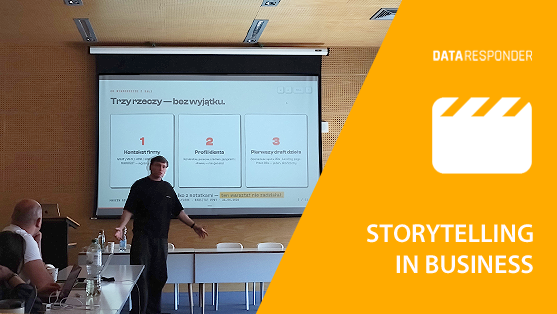
Participation in the event “Crack the Hollywood Code – AI-supported storytelling for your business”, organized by the Pomeranian Science and Technology Park in Gdynia, was an opportunity to look at business communication from a completely different perspective. Not through the lens of product features, a list of services, or yet another set of sales arguments, but through the structure of a story that engages the audience’s attention.
The training, led by Marcin Niemkiewicz – a film director and AI consultant – showed that the best advertisements, films, and marketing campaigns often use similar narrative frameworks. One of them is Save the Cat, a popular storytelling structure used in Hollywood.
In business, the company is not the hero
One of the most important takeaways from the training was that in brand communication, the hero of the story should not be the company or the product. The hero is the customer.
A company should not talk only about what it does, what features it has, and why it is the best. A more effective story shows:
- what problem the customer is facing,
- what is blocking them from making a change,
- what risk or tension accompanies their situation,
- how the product or service helps them go through a transformation,
- what the customer’s world looks like “after the change”.
This is an important difference. The product is not the hero. The product is a tool, a mentor, or a form of support that helps the customer achieve their goal.
Save the Cat: a structure that organizes the story
The Save the Cat model can be treated as a practical map for building a narrative. In film, it guides the viewer through the hero’s story: from the problem, through a turning point, crisis, transformation, and finale. In business, it can work in a similar way.
In simple terms, a good brand story may look like this:
- Opening: we show the customer’s world and the problem they are facing.
- Tension: the customer sees that their existing solutions are no longer enough.
- Turning point: a new way of thinking, product, service, or method appears.
- Attempt at change: the customer starts taking action, but encounters obstacles.
- Crisis: it becomes clear that something more important is at stake than the product feature itself.
- Transformation: the customer understands what they really need to change.
- Finale: we show the result – the customer in a new, better situation.
This kind of structure helps avoid messages that are correct but bland. Instead of saying “we have a great solution”, we show the journey from problem to change.
How can storytelling be used in company content?
Hollywood narrative frameworks can be used not only in advertising films. They also work well in everyday business communication.
Example applications:
- Blog post – instead of a dry guide, you can start with a real customer problem, show its consequences, and only then move on to the solution.
- Social media post – the first sentence should work like a hook, capturing the audience’s attention in the first few seconds.
- Advertising film – the customer should go through a visible change: from frustration, chaos, or lack of control to clarity, results, and a sense of agency.
- Website – instead of starting with “about us”, it is worth starting with the audience’s problem and showing why the current way of doing things is no longer enough.
- Sales or investor pitch – a good narrative shows not only the product, but also the stakes, the market shift, and the consequences of inaction.
Hook: the first seconds determine attention
In a world overloaded with content, being correct is not enough. Attention must be earned immediately. That is why hooks were an important element of the training: ways of opening a message so that the audience wants to keep reading or watching.
A good hook can:
- show a surprising observation,
- name a problem the audience has not yet been able to name,
- reverse a typical assumption,
- build tension between what the customer is doing today and what they should do differently.
Example: instead of writing “How to improve brand communication?”, you can start with the sentence: “Most companies do not lose because they have a weak product. They lose because they talk about it in a boring way”.
Where does AI help in all of this?
Artificial intelligence should not be treated solely as a generator of ready-made texts. In that case, it is easy to end up with content that is correct but similar to everything that already exists. Much greater value comes from using AI as a creative partner.
AI can help especially at several stages:
- Industry research – quickly gathering information about the market, competitors, trends, and customer language.
- Building brand context – organizing values, tone of communication, personas, objections, and differentiators.
- Generating story variants – creating several possible narratives around one product or service.
- Reverse thinking – asking AI first for a “typical” story and then for its reversal in order to find a more surprising idea.
- Creating graphics and video – preparing visual concepts, storyboards, shots, scenes, or supporting materials for a campaign.
What matters most, however, is that AI needs good context. The better we “feed” it with knowledge about the brand, the customer, the tone of communication, and the goal of the content, the more useful the results will be.
AI does not replace strategic thinking
The biggest trap is that AI can very easily produce content that sounds professional but has no clear point of view. That is why, before generating texts, graphics, or scripts, it is worth answering a few questions:
- Who is the hero of this story?
- What problem are we really trying to show?
- What should change in the audience’s thinking?
- What are the stakes of this change?
- What will be surprising, and what will merely be obvious?
AI speeds up the work, but it does not remove the need to make strategic decisions. Without a good direction, it will produce more content, but not necessarily better content.
A practical framework for working on a message
The combination of storytelling and AI can be reduced to a simple process that works for a blog post, advertisement, film script, or sales presentation.
- Define the customer as the hero – describe their situation, problem, and goal.
- Name the conflict – show what is currently making change difficult.
- Define the turning point – introduce a new perspective, method, or solution.
- Build the transformation – show how the customer moves from the problem to a better state.
- Use AI for variants – generate several versions of the hook, script, post, or storyboard.
- Reject clichés – check whether the story sounds like hundreds of other pieces of content on the internet.
- Refine the finale and CTA – show the audience what they should do after reading or watching the message.
Conclusions
Storytelling in business is not about “telling nice stories”. It is a way of organizing communication so that the audience can see themselves, their problem, and a possible change. The Save the Cat model helps build content that has tension, a turning point, and a finale. As a result, company messages can be more engaging – regardless of whether we are talking about a blog post, advertisement, promotional film, website, or sales pitch.
Artificial intelligence strengthens this process when we use it consciously: for research, building context, searching for variants, reversing obvious ideas, and creating visual and video materials. The most important change, however, lies in perspective: the company is not the hero of the story. The hero is the customer, who, thanks to the right narrative, can see that change is possible.