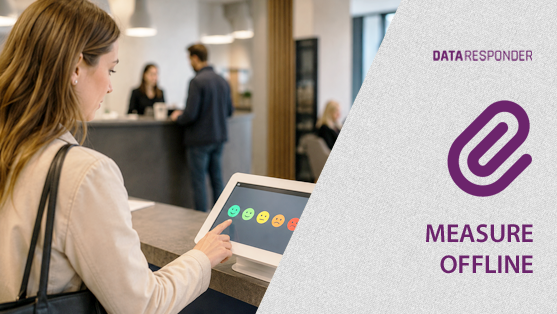

Customer experience does not happen only online
Many service companies measure customer experience mainly through online channels: email surveys, post-visit forms, SMS links, Google reviews, post-transaction messages or forms on their website.
It is convenient, fast and easy to automate. The problem is that the customer experience very often happens somewhere else: at reception, at the checkout, in the waiting room, at the service desk, at the table, in the treatment room, in the salon, at the branch or during a face-to-face conversation.
If a company measures CX only online, it sees only part of reality. Often it is the part that is easiest to measure, but not necessarily the part that best reflects the quality of the experience.
Offline has a voice too. And in many service industries, it is a voice that should not be ignored.
Why online is not enough
Online feedback is important, but it is not a neutral image of the entire customer population. For a customer to answer an online survey, they must receive the link, have time, notice the message, want to click and go through the form. Already at this stage, some experiences disappear from measurement.
Most often, the following are left out:
- customers who do not want to leave contact details,
- customers who do not open email or SMS messages,
- people who are less digitally active,
- customers who wanted to leave quick feedback “here and now”, but later never returned to it,
- people who had an average experience and do not feel motivated to complete a survey,
- customers who left the location dissatisfied but did not leave any trace in the online system.
As a result, the company may have data, but not the full picture. And an incomplete picture leads to incomplete decisions.
Offline is closest to the moment of experience
One of the greatest advantages of offline feedback is its closeness to the moment when the experience actually happened. A customer can rate the visit, service or a specific stage of the process immediately, before they forget the details or before emotions are covered by other matters.
This matters because, in services, details count:
- did the customer have to wait longer than expected?
- did someone notice them when they entered?
- was the staff helpful?
- was communication clear?
- was the process simple?
- was the problem solved without additional effort?
Such signals are best collected close to the place and time of the experience. If you ask the customer two days later, you may get a more general answer. If you ask them at the touchpoint, you can capture a specific problem.
In services, place matters
Service companies often operate across many locations, points, branches, salons or teams. In such a model, a general online survey may show an average score, but it will not always show exactly where the problem is emerging.
Meanwhile, the customer experience may differ significantly depending on the place:
- one location has excellent service but a long waiting time,
- another has an efficient process but weaker communication,
- in one branch the problem appears in the morning, in another in the afternoon,
- the weekend experience may look different from the weekday experience,
- a new team may generate different problems than an experienced team.
If feedback is not connected with place, time and touchpoint, it is difficult to turn it into an operational decision.
Offline allows you to place feedback in a specific context: here, now, in this location, after this interaction.
Online reviews often show extremes
Public online opinions and reviews are valuable, but they have their own characteristics. They often come from particularly motivated people: either very satisfied or very dissatisfied. This may amplify extremes and make it harder to understand the everyday, typical customer experience.
The company may then receive signals mainly from two groups:
- delighted customers who want to praise the service,
- frustrated customers who want to warn others or express dissatisfaction.
What is missing is the voice of customers “in between”: those who were not angry, but also not delighted; those who encountered minor friction; those who will not return, but will not write a review either.
It is often in this group that the most important signals for quality improvement are hidden. They are not dramatic, but recurring. They do not explode into a crisis, but gradually reduce loyalty.
Offline feedback helps detect friction in the process
In service companies, many problems do not result from bad intentions of employees or low service quality. Often the problem is friction in the process: too long a waiting time, unclear information, a queue, no one at the desk, an unclear procedure or the need to ask about basic things.
The customer feels such problems immediately. But they will not always report them later online.
That is why it is worth measuring experience in the places where friction actually occurs:
- at the entrance or reception,
- after completed service,
- after a visit to a branch,
- after a conversation with a consultant,
- after receiving a service or product,
- after solving a problem, complaint or request.
The closer the measurement is to the process, the greater the chance that feedback will be specific and operationally useful.
Online and offline should not compete with each other
This is not about replacing online feedback with offline feedback. That would be another oversimplification. Mature CXM should combine both sources.
Online works well when you want to:
- reach the customer after some time,
- ask about the relationship with the brand,
- collect a more detailed response,
- run a recurring study,
- connect feedback with the customer’s history in a CRM system.
Offline works well when you want to:
- capture feedback right after the experience,
- measure a specific touchpoint,
- compare locations or teams,
- collect quick feedback from customers who will not respond online,
- detect operational problems at the place where the service is delivered.
The greatest value comes from combining both perspectives. Online shows the relational and digital part. Offline shows the real experience at the point of contact.
QR, terminal, form: different channels, one goal
Offline feedback does not have to mean paper surveys or complicated field research. In practice, it can be collected in simple ways, adapted to the customer’s situation.
Example channels include:
- a QR code placed at reception, at the table, on the receipt, at the exit or in the waiting room,
- a feedback terminal at the service point, allowing customers to rate the experience quickly,
- a short form available on a tablet or device at the location,
- a contextual link assigned to a specific location, event or touchpoint,
- a form connected with service triggered after a visit, request or interaction has been completed.
The key is that the channel should not make it harder for the customer to respond. The easier the access to the form, the greater the chance that the company will hear the customer’s voice while the experience is still fresh.
The context of feedback matters most
The information that a customer rated the service 3 out of 5 is not enough. For feedback to be useful, you need to know what it referred to.
That is why every measurement should be placed in context:
- which location?
- which channel?
- which touchpoint?
- which moment in the Customer Journey?
- which day and time?
- which type of service or case?
- which driver influenced the rating?
Without this, feedback is only an opinion. With context, it becomes a management signal.
It is precisely context that makes it possible to distinguish a systemic problem from an incident, a process error from team overload, and a low service rating from frustration related to waiting.
Example: restaurant, clinic, salon, service point
Imagine a service company that collects feedback only by email after a visit. A small share of customers responds. The overall result looks stable, so the company assumes that quality is under control.
After adding offline feedback, however, it turns out that:
- in one location, customers often complain about waiting time,
- during peak hours, the number of neutral and negative ratings increases,
- customers do not complain about the service itself, but about the lack of information before being served,
- people who would not respond to an online survey are happy to leave short feedback via QR or terminal,
- the problem repeats in a specific touchpoint, not across the whole experience.
The conclusion is completely different. The company does not have to “improve everything”. It can act precisely: change the schedule, improve communication in the waiting room, introduce simple information about waiting time or reorganize the first stage of customer service.
This shows why offline is not an add-on. Offline often reveals problems that online does not show early enough.
How not to fall into the trap of collecting everything
Combining online and offline does not mean that every possible moment has to be measured. Too many surveys can tire customers and flood the organization with data that no one analyzes.
A better approach is to choose key touchpoints where feedback has the greatest operational value.
It is worth starting with questions:
- where does the customer most often experience friction?
- at which moment is it easiest to lose the customer’s trust?
- which stages influence repeat visits, recommendations or complaints?
- where do managers need a quick quality signal?
- which locations or channels require comparison?
A good measurement system is not about asking everywhere. It is about asking where the answer can lead to a decision.
The role of Data Responder in connecting online and offline feedback
Data Responder supports an approach in which feedback is not limited to one channel. The application allows companies to collect customer opinions both online and offline, and then analyze them within one data model.
In practice, this means the ability to connect several elements:
- online forms – for customers who respond later or remotely,
- QR codes – for collecting feedback in a specific place and moment,
- feedback terminals – for quick ratings at the location,
- Customer Journey and touchpoints – so that each opinion is assigned to the right stage of the experience,
- segmentation – to compare results by time, place, channel and context,
- CX drivers – to understand what influences the customer’s rating,
- dashboards and corrective actions – so that feedback leads to decisions, not only to reports.
This allows a company to see not only the overall score, but also the differences between channels. It can check whether online and offline customers are saying the same thing, or whether they show two different pictures of the experience.
Conclusions
Service companies should not measure CX only online, because the customer experience very often happens offline: in the place, time and context of a specific interaction.
Online feedback is important, but it may miss some customers, some situations and some operational problems. That is why it is worth combining it with offline measurement, especially where quality depends on people, place, process and the moment of service.
For CX measurement to be useful, it should:
- cover key online and offline touchpoints,
- be close to the moment of experience,
- include the context of location, time, channel and Customer Journey stage,
- connect ratings with CX drivers and customer comments,
- lead to corrective actions, not only to reporting.
Online shows part of the story. Offline shows what happens in real contact with the customer.
Only by combining both perspectives can a service company gain a fuller picture of the experience and a better chance of real quality improvement.