
What Customer Journey is – and why many companies misunderstand it
Customer Journey describes the sequence of experiences a customer goes through when interacting with a company. It is not an organizational process or a list of channels, but the customer’s perspective – from the first contact to the ongoing relationship.
The problem is that in many organizations Customer Journey:
- is created as a presentation rather than a tool,
- has no connection to data,
- is not used operationally.
As a result, a document is created that “everyone has seen” but no one actually uses.
What Customer Journey is – and what it is not
Customer Journey is:
- a description of experiences from the customer’s perspective,
- a logical sequence of stages and touchpoints,
- a framework for analyzing experience quality,
- a decision-making tool.
Customer Journey is not:
- an internal company process,
- a list of communication channels,
- a CRM workflow or a sales funnel,
- a one-off workshop artifact.
This distinction is critical if the Journey is meant to deliver real value.
What is Customer Journey used for in practice?
A well-designed Customer Journey helps to:
- understand where the experience is actually created,
- identify key touchpoints,
- define where it makes sense to measure quality,
- compare experiences across different stages of the process.
Customer Journey does not answer the question “what is happening”, but helps answer: “where and why the experience works or breaks down”.
How is a Customer Journey created?
A Customer Journey is created iteratively and always in a simplified form. The goal is not completeness, but usability.
Basic steps:
- define the beginning and end of the journey,
- divide it into logical stages from the customer’s perspective,
- identify key touchpoints,
- define the customer’s goal at each stage.
At this stage, you do not need personas or emotional maps. Structure is what matters most.
A simple Customer Journey example
For a brick-and-mortar café, a simplified Customer Journey might look like this:
- Entering the venue
- Placing an order
- Waiting
- Consumption
- Leaving
Each of these stages:
- has a different context,
- comes with different expectations,
- requires a different approach to measurement.
Measuring “overall satisfaction” without reference to the stage explains nothing.
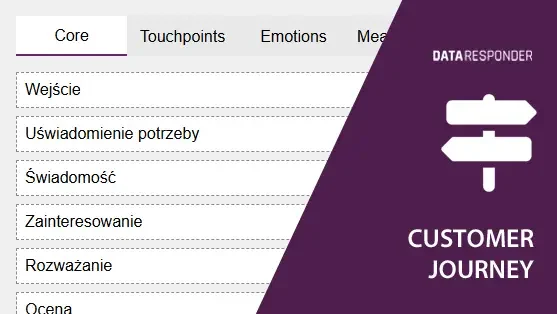
Customer Journey in Data Responder – a measurement map
In Data Responder, Customer Journey plays a clear, operational role.
The Journey is used to:
- place forms and terminals within specific stages,
- link feedback to a concrete touchpoint,
- analyze experience quality stage by stage,
- compare results across different moments of the process.
As a result, feedback:
- is no longer an anonymous opinion,
- has a clear context,
- can be meaningfully aggregated and segmented.
Customer Journey thus becomes the axis of the entire measurement system.
Common mistakes when working with Customer Journey
- overly detailed, overloaded maps,
- no connection to real touchpoints,
- creating a Journey without using it later,
- measuring everything everywhere.
The simpler and more functional the Journey, the greater its value.
Conclusions
Customer Journey is not a goal in itself. Its value lies in the fact that it:
- structures how you think about customer experience,
- points to meaningful measurement locations,
- enables the shift from opinions to decisions.
In Data Responder, Customer Journey is not a presentation – it is a map of experience measurements. Without it, feedback loses context. With it, feedback becomes a real CX management tool.