
Touchpoint – what it is and why it matters
A touchpoint is a specific moment of interaction between a customer and a company, whether online or offline. A touchpoint can be a conversation with support, a delivery, a visit to a location, a payment screen, a post-purchase email, or a service interaction.
Most importantly, a touchpoint is not “a place for a survey”. It is a moment when the customer:
- forms an opinion,
- makes a decision (stay / leave / recommend / return),
- experiences an emotion (trust, frustration, relief, surprise).
If you misunderstand touchpoints, you may measure a lot – but learn very little.
Touchpoint as a decision moment, not a survey slot
In a mature approach, a touchpoint is a moment of truth: the point at which service quality, product, or process has a real impact on customer behavior.
That is why the right question is not “where can we place a form?”, but:
- where does the customer form an evaluation of the experience?
- which moments have the strongest impact on loyalty and return?
- where does frustration most often occur?
A touchpoint only matters if it leads to insights and decisions.
Where to measure? Choose high-impact touchpoints
Do not measure everything. Measure where the result can actually change something.
High-impact touchpoints usually meet at least one of the following criteria:
- they involve risk or stress (complaints, delays, issues),
- they create a “first impression” (first contact, onboarding),
- they are a “moment of truth” (payment, delivery, service completion),
- they have the strongest influence on overall perception (service, time, execution quality).
For example, in a restaurant, measuring feedback after the visit usually delivers more value than measuring during the ordering process.
When to measure? Too early and too late are both mistakes
Timing is just as important as location.
Too early:
- the customer has not yet experienced the full journey,
- the evaluation concerns only a fragment (often random),
- responses are based on incomplete context.
Too late:
- details are forgotten,
- responses become overly general,
- the opportunity for quick reaction is lost.
A good rule of thumb: measure as close to the experience as possible, but only when the customer has enough context to evaluate what you are measuring.
What not to measure? Three traps that ruin data quality
There are places and moments where measurement rarely makes sense.
Do not measure when:
- the customer has no real choice (e.g. “I have to pick up the package” is not a decision),
- the touchpoint has no real impact (measuring “by default” creates noise),
- the channel is intrusive (forcing surveys lowers response quality and trust).
If the customer feels interrupted, you are measuring irritation – not experience quality.
Example: touchpoints in a café Customer Journey
A simplified café Customer Journey:
- Entering
- Ordering
- Waiting
- Consumption
- Leaving
High-impact touchpoints in this journey:
- waiting time (especially during peak hours),
- service quality at the counter,
- problem resolution (e.g. a mistake in the order).
In this case, measuring feedback at the exit (via QR or terminal) often provides a more complete picture than surveying during the ordering stage.
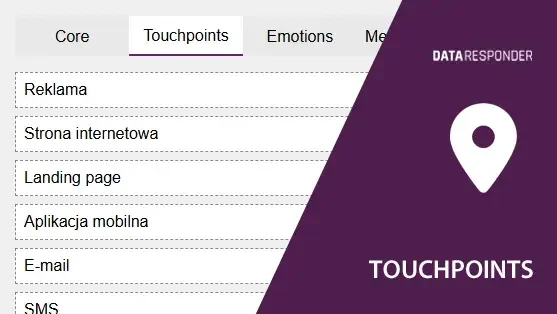
Touchpoints in Data Responder – turning moments into a measurement map
In Data Responder, a touchpoint is not an abstract concept. It is a concrete measurement anchor within the Customer Journey.
Touchpoints allow you to:
- attach forms, QR codes, or terminals to specific stages,
- collect feedback with clear context (where and when the evaluation was formed),
- compare results across different touchpoints,
- avoid misleading conclusions caused by “averages without context”.
As a result, data is not a random set of ratings, but a map of experience quality across real moments in the journey.
Conclusions
A touchpoint is not a survey location. It is the moment when the customer makes a decision and forms an opinion.
If you want data that actually leads somewhere:
- measure only high-impact touchpoints,
- get the timing right (not too early, not too late),
- avoid measurements that generate noise and irritation.
In Data Responder, touchpoints are a practical tool that turns Customer Journey into a measurement map rather than a presentation.