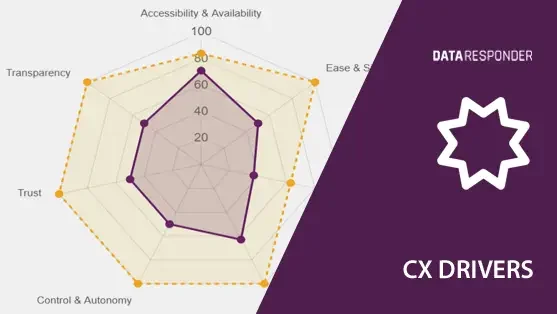

CX Drivers – why this concept is so often misunderstood
In CX, the term “driver” is overused because it sounds professional. In practice, many companies create a list of drivers that is:
- a collection of vague labels,
- a copy of survey questions,
- a mix of KPIs and product features,
- or a wish list (“faster and nicer service”).
In this form, drivers do not explain results and do not lead to decisions.
What is a CX driver?
A CX driver is a generalized area of experience that has a significant impact on how customers evaluate the quality of their interaction with a company.
A driver:
- is a higher-level category (e.g. time, service, reliability),
- groups multiple specific observations into a meaningful theme,
- enables consistent analysis across touchpoints,
- is broad enough to apply in many contexts, yet specific enough to be improved.
Simply put, a driver is the reason why a customer gives a particular rating.
What a driver is not
To avoid confusion, it is important to clearly separate concepts.
A driver is not a question
A question is a measurement tool. A driver is the area to which questions are assigned.
- question: “Was the service helpful?”
- driver: “Service quality”
A driver is not a metric
A metric is a calculated result (e.g. an average score). A driver is an interpretation layer.
- metric: “average rating 4.2”
- driver: “Waiting time”
A driver is not a product feature
Features (e.g. “live chat”) are part of the solution. A driver describes the experience, which can be good or bad regardless of the tool.
- feature: “SMS notifications”
- driver: “Clarity of communication”
If you mix these levels, you lose the ability to compare results and plan actions.
Why define CX drivers at all?
Without drivers, you are left with raw responses that are hard to translate into quality management. Drivers bridge the gap between data and decisions.
Defining drivers allows you to:
- analyze results by themes, not individual questions,
- compare experience quality across touchpoints and locations,
- see what has the strongest impact on overall evaluation,
- set priorities for corrective actions.
This is the difference between “a dashboard of ratings” and real CX management.
How to design meaningful CX drivers
Drivers should reflect your business and real customer experiences – not a generic list copied from the internet.
A practical approach:
- start with 5–8 drivers (less is more),
- name them in language your organization understands,
- make sure each driver is actionable (you can improve it),
- avoid drivers that are too broad (“quality”) or too narrow (“parking at the entrance”).
Good examples of drivers:
- Time and process flow
- Service quality
- Clarity of communication
- Reliability / error-free experience
- Product or service quality
How do drivers relate to questions in a form?
A driver is the “headline”; questions are the “sensors”.
Typically, multiple questions are assigned to one driver. For example, for the driver “Time and process flow”:
- “How would you rate the waiting time?”
- “Was the process simple and hassle-free?”
- “What slowed the process down the most?” (open-ended)
This way, results are not random – you can see which area of the experience drives the score.
CX drivers in Data Responder – why the application requires them
Data Responder requires defined drivers because they are essential to turning feedback into a quality management system.
Drivers in the application make it possible to:
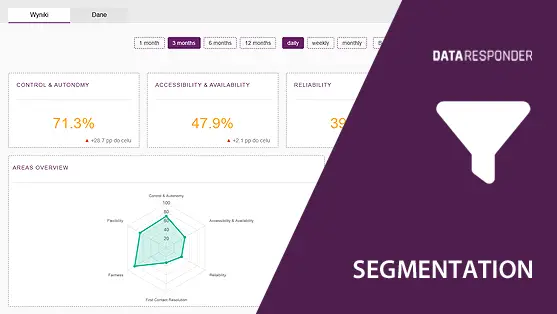
- aggregate results not only by surveys, but by experience areas,
- compare driver performance over time, across locations and touchpoints,
- create reports that explain “what works and what doesn’t” in management language,
- prioritize corrective actions and verify their impact.
Without drivers, the system sees only answers. With drivers, it sees causes and levers for change.
Conclusions
A CX driver is a generalized area of experience that truly influences customer evaluation – and can be improved.
For drivers to work:
- do not confuse drivers with questions, metrics, or features,
- keep the list short and actionable (e.g. 5–8 drivers),
- link questions to drivers to understand the “why”.
In Data Responder, drivers are the foundation of CX analytics, enabling the shift from opinions to decisions and corrective actions.