
Introduction
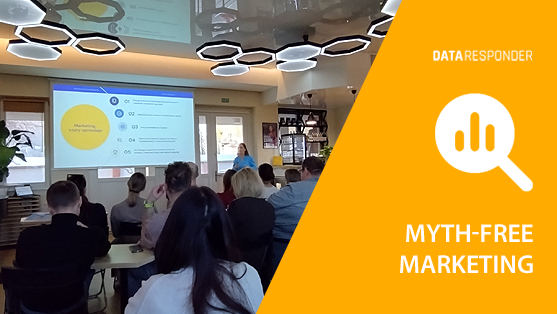
Participation in the 59th edition of CRASH Mondays in Gdynia, organized at the Konsulat Kultury, was a good opportunity to talk about what really works in marketing and what only looks good in presentations, reports, and social media. One of the most important talks of the evening was the presentation by Agnieszka Borowczyk – a marketing and sales strategist, consultant, and founder of Digital Mentoring.
Agnieszka showed marketing without embellishment: based on data, the purchasing process, real customer needs, and a clear competitive advantage. It was not about another trendy tool, yet another campaign, or chasing trends. It was about a simple question: do our marketing activities actually help sell?
Marketing is not ads, graphics, and gadgets
One of the strongest conclusions from the talk was the reminder that marketing should not be reduced to ads, images, gadgets, or publishing content “because that is what you are supposed to do.” These are only tools. On their own, they do not solve the problem if a company does not know who it is speaking to, what it promises, and why the customer should trust it.
Marketing that sells starts much earlier than an advertising campaign. It starts with understanding:
- who the right customer is,
- what problem the customer is really trying to solve,
- what blocks the purchasing decision,
- why the offer should be a better choice than the alternatives,
- how marketing, sales, and management can play on the same team.
Without this, it is easy to fall into the trap of activities that look professional but do not move the customer closer to a decision.
An offer for everyone is an offer for no one
The topic of offer fit came through strongly in the presentation. If a company tries to speak to everyone, it usually does not reach anyone strongly enough. Communication that is too broad dilutes the message, makes it harder to show value, and causes the customer not to see why a given offer is specifically for them.
Good marketing is not about saying more. It is about saying things more precisely. Hitting the customer’s strongest pain points, using language they understand, and showing the solution in the context of their situation.
This is especially important in companies that have many services, many target groups, and many messages at once. That is when chaos can easily appear: each product gets its own narrative, each channel speaks a slightly different language, and the customer is left with the question: “is this actually for me?”
The full-fridge syndrome, or why more does not always mean better
An interesting image from the talk was the “full-fridge syndrome.” This is a situation in which a company adds another service to its offer, then another one, and then one more, hoping that a broader offer will automatically increase sales.
In practice, the opposite often happens. The more elements there are without a clear logic, the harder it is for the customer to understand what matters most. The offer begins to resemble an overloaded fridge: there is supposedly everything inside, but it is difficult to quickly find what we really need.
A better offer is not always a bigger offer. Sometimes the greatest value lies in simplifying, organizing, and showing the customer a specific path to making a choice.
Metrics that matter
Agnieszka also drew attention to the problem of indicators that look good in reports but say little about the real effectiveness of marketing. Reach, likes, or synthetic activity metrics alone can create a false sense of success.
Much more important are metrics that show the impact on sales and business growth, such as:
- the real cost of acquiring a lead,
- the conversion rate at successive stages of the process,
- customer lifetime value,
- customer return rate,
- lead quality, not just the number of leads.
These are the metrics that make it possible to answer the question of whether marketing really supports sales or only produces activity. Without such data, it is easy to make decisions based on impressions rather than facts.
Strategy as a decision-making filter
One of the most important elements of the presentation was showing strategy as a decision-making filter. Strategy is not a document for a drawer or a collection of catchy slogans. It is a tool that helps distinguish necessary actions from distractions.
Ideas such as the following should pass through this kind of filter:
- “let’s make more posts,”
- “let’s launch a new channel,”
- “let’s copy what the competition is doing,”
- “let’s throw in something with AI,”
- “we need a viral campaign.”
Not every idea is bad. The problem begins when decisions are made without answering the question: does this bring the customer closer to buying and support our business goals?
AI will not replace strategy
The talk also touched on the topic of ads and content generated by AI. This is an important issue, because today it is very easy to be impressed by form: the speed of creating graphics, texts, videos, or campaigns.
But form alone does not determine effectiveness. An ad generated by AI may look modern, but if it does not lead the customer through a well-thought-out purchasing path, it remains just another message in the information noise.
The result is still determined by strategy: understanding the customer, a good offer, the right moment, a clear message, and measuring the effects. AI can speed up work, but it should not replace thinking.
Practical tips for companies
Several very concrete lessons can be drawn from the talk for companies that want to organize their marketing:
- Do not start with tools – first define the customer, the problem, the offer, and the purchasing process.
- Do not speak to everyone – clarify who the offer is truly valuable for.
- Do not add services without a strategy – a bigger offer may increase chaos, not sales.
- Measure what affects the business – lead cost, conversion, retention, and customer value.
- Treat AI as a tool – not as a substitute for strategy.
- Check where the customer gets stuck – friction in the purchasing process often costs more than the lack of another campaign.
Conclusions
Agnieszka Borowczyk’s talk during CRASH Mondays #59 was a strong reminder that marketing should not be a theater of activity. It is not about doing more, faster, and louder. It is about doing the right things – consciously, consistently, and based on data.
Marketing that sells is not based on myths, trends, and empty promises. It is based on understanding the customer, a good offer, competitive advantage, the purchasing process, and measurable results.
This approach may be less flashy than promises of instant results, but it is definitely more useful. Especially for companies that want to build sales not through chaos, but through clarity, courage, and consistency.