
CXM – what Customer Experience Management really is
Customer Experience Management (CXM) is the management of the entire customer experience across all interactions with an organization – from marketing and sales, through service usage, to post-sale support.
In practice, CXM means:
- designing and controlling key moments of the customer experience,
- measuring quality at touchpoints,
- analyzing root causes (why customers rate experiences the way they do),
- implementing corrective actions,
- and verifying the impact on business KPIs.
Simply put: CXM is a system of work, not a one-off initiative.
CXM is not “collecting feedback” – how it differs from surveys
Collecting feedback is important, but it is only one component of CXM.
Feedback alone gives you:
- a signal that something works or doesn’t,
- a starting point for investigation.
CXM adds:
- context (where and when the rating was formed),
- a cause-and-effect model (CX drivers),
- priorities (what to fix first),
- execution (who does what and when),
- impact monitoring (whether changes affect KPIs).
Without these elements, organizations may “know” – but they do not “manage”.
What is CXM used for in practice?
CXM only makes sense if it leads to decisions and change. In practice, CXM helps to:
- maintain consistent experience quality across locations and channels,
- detect problems earlier than sales reports or complaints,
- reduce service costs by eliminating friction in processes,
- increase retention and loyalty,
- turn the voice of the customer into concrete organizational actions.
This is especially critical in service-driven businesses where experience depends on people and processes, not just products.
CXM as an operational cycle
Mature CXM operates as a loop. This is essential – without a loop, you only have isolated initiatives.
The core CXM cycle:
- Map the Customer Journey (stages and touchpoints)
- Design measurement at key touchpoints
- Collect feedback online and offline
- Segment and analyze results (time, location, channel)
- Explain the “why” using CX drivers and comments
- Plan corrective actions and assign ownership
- Verify impact (quality trends and business KPIs)
What defines CXM is that measurement is only one step in this cycle.
Example: CXM in a service business (simple scenario)
Imagine a company with multiple locations struggling with customer churn.
Using a CXM approach, you might:
- map the Customer Journey (e.g. contact → visit → service → completion),
- measure CSAT after visits and CES after issue resolution,
- segment results by location and time of day,
- identify “time and process flow” as the main CX driver behind negative feedback,
- implement changes (e.g. better scheduling, additional staff during peak hours),
- check after a month whether negative feedback decreased and retention improved.
This highlights the difference: you are not “collecting ratings”, you are managing quality and its impact.
How Data Responder supports CXM in practice
Data Responder is designed to support the entire CXM cycle, not just surveys.
In practice, the platform helps you:
- anchor measurement in the Customer Journey and touchpoints,
- collect feedback in a hybrid way: forms, QR codes, terminals,
- define CX drivers as an interpretation layer,
- automatically segment data by time, location, and context,
- monitor quality metrics on dashboards,
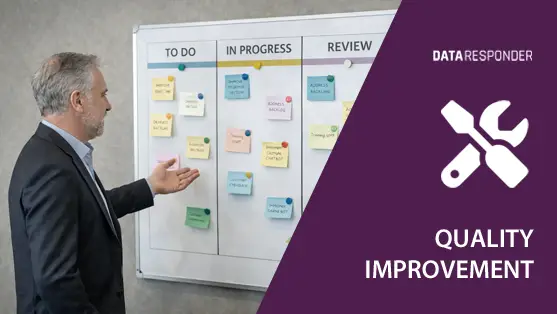
- manage corrective actions in a kanban board,
- link experience quality with business KPIs via imported reference data,
- receive alerts when negative feedback increases.
This aligns with the core idea of CXM: measure → diagnose → act → verify.
Common mistakes when implementing CXM
- treating CXM as a short-term project instead of an ongoing process,
- measuring everything instead of focusing on key touchpoints,
- lack of segmentation (averages hide real problems),
- missing drivers (“we know it’s bad, but not why”),
- no execution of corrective actions,
- no link to KPIs (CXM seen as a cost, not an investment).
If you recognize these symptoms, the issue is usually not the tool, but the operating model.
Conclusions
Customer Experience Management (CXM) is an end-to-end system for managing experience quality. It does not stop at surveys.
For CXM to work in practice:
- embed measurement in the Customer Journey and touchpoints,
- analyze root causes using drivers and segmentation,
- execute corrective actions with clear ownership,
- verify results over time and link quality to business KPIs.
When done right, CXM stops being “feedback collection” and becomes a real management tool.